Evaluating Accounting Ledger Book KDP Interiors for Self-Publishing
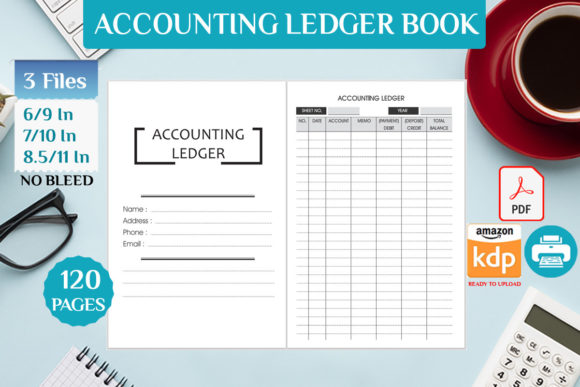
For self-publishers and low-content book creators, the difference between a generic notebook and a functional financial tool lies entirely in the interior design. An Accounting Ledger Book KDP Interior serves as the structural backbone for entrepreneurs, freelancers, and small business owners who prefer physical record-keeping or require supplementary offline tracking. Unlike lined journals, these interiors demand precision; a misaligned column or an unclear header renders the book useless for its intended purpose. When evaluating pre-made interiors for Amazon KDP, the focus must shift from aesthetic appeal to technical compliance and practical utility. The specific configuration of 6″ x 9″, 7″ x 10″, and 8.5″ x 11″ formats, combined with 120-page counts and bleed options, addresses distinct market segments within the financial niche.
Technical Specifications and Print Compliance
The primary value proposition of a professional Accounting Ledger Book interior is immediate compatibility with KDP’s printing standards. Technical rejection is a common friction point for publishers, often caused by incorrect margin settings or bleed miscalculations. High-quality interiors in this category are engineered to eliminate these errors. The availability of three distinct trim sizes allows publishers to target specific user behaviors without resizing files manually, which often degrades line crispness.
- 6″ x 9″ (Compact): This size functions as a portable ledger for sole proprietors, market vendors, or personal finance trackers. It fits easily into bags and glove compartments, making it ideal for on-the-go expense logging. The smaller footprint requires efficient use of whitespace to maintain readability.
- 7″ x 10″ (Intermediate): A versatile middle ground that offers more horizontal space for transaction descriptions than the 6x9 format while remaining less cumbersome than full letter size. This dimension is frequently preferred by service-based freelancers who need adequate writing room without the bulk of a standard office binder.
- 8.5″ x 11″ (Standard): The traditional accounting size providing maximum column width for detailed entries, multiple sub-categories, or larger handwriting. This format is best suited for stationary business use, inventory tracking, or comprehensive annual ledgers where data density is high.
All three dimensions typically come standardized at 120 pages. This page count strikes a strategic balance for KDP publishing. It provides sufficient volume for quarterly or annual tracking, justifying a higher price point than thinner notebooks, yet remains thin enough to keep printing costs low and spine width manageable. For an Accounting Ledger Book, 120 pages usually translates to roughly 58 double-page spreads, offering ample capacity for daily or weekly entries without resulting in an unwieldy product.
Navigating Bleed vs. No Bleed Options
The distinction between bleed and no bleed files is critical for ledger functionality. Financial records require clear boundaries; users must be able to draw straight lines and read figures near the gutter without visual obstruction. Professional KDP interiors provide separate PDF files for both configurations because the safe zones differ significantly.
No Bleed: In this configuration, all content sits within a defined safe margin. This is generally the superior choice for accounting ledgers. Columns, headers, and totals remain fully visible regardless of binding variance. It ensures that no numerical data is lost in the spine crease, which is essential for accuracy and usability.
Bleed: Bleed versions extend background elements or grid lines to the edge of the paper. While aesthetically modern, bleed interiors for accounting require careful evaluation. If the columns themselves bleed, users may struggle to write near the edges. However, if only decorative borders or subtle watermarks bleed while the functional grid remains safely inset, this option can enhance perceived value. Publishers must verify that the provided bleed PDF accounts for the requisite 0.125-inch extension beyond the trim line to prevent white edges after cutting.
Functional Design and User Experience
A technically compliant file does not guarantee sales or positive reviews. The Accounting Ledger Book must solve actual organizational problems. Real-world usability depends on the logical arrangement of columns and the clarity of typography. When assessing these interiors, one must look beyond the cover potential and scrutinize the spreadsheet layout itself.
Effective ledger interiors prioritize column hierarchy. Date, Description, Category, Debit, Credit, and Balance columns should be intuitively spaced. A common failure in low-quality interiors is insufficient width in the "Description" field, forcing users to abbreviate excessively. Conversely, overly wide numeric columns waste valuable horizontal real estate. The best templates demonstrate an understanding of double-entry bookkeeping basics or simplified cash-basis tracking, depending on the target audience.
Typography plays a silent but vital role. Headers must be legible at small point sizes to maximize writing space. Sans-serif fonts with open counters tend to perform better in print than ornate serifs, especially on standard KDP cream or white paper where ink spread can occur. Furthermore, line weight matters; lines that are too thick consume writing space and create visual clutter, while lines that are too faint may disappear during printing. A balanced, hairline-to-medium stroke weight ensures the grid supports the handwritten content without competing with it.
Paper Quality Considerations for Financial Records
Publishers must manage expectations regarding KDP’s standard paper stock when marketing an Accounting Ledger Book. Standard color or black-and-white paper is 55# (90 GSM), which is suitable for ballpoint pens and pencils but may ghost with gel pens or markers. Since financial professionals often use various writing instruments, the interior design should accommodate this limitation. Generous spacing between rows helps mitigate bleed-through visibility. Some high-quality interiors incorporate alternating row shading or heavier separator lines every five rows to aid readability and reduce eye strain, a feature that adds significant functional value despite the paper constraints.
Strategic Audience Alignment
Understanding who actually buys these books prevents wasted ad spend and poor product-market fit. The Accounting Ledger Book KDP Interior is not a monolith; different specifications serve different demographics.
Small Business Owners and Sole Proprietors: This group often seeks tax-ready documentation. They benefit most from the 8.5″ x 11″ format with structured columns matching Schedule C categories. Reliability and professional presentation are paramount; they view the book as a business asset rather than a stationery item.
Freelancers and Gig Workers: Income streams for this demographic are often irregular and multi-sourced. The 7″ x 10″ or 6″ x 9″ formats appeal here due to portability. These users often prefer simplified income/expense trackers over complex double-entry systems. Flexibility in column headers is a selling point.
Personal Finance Enthusiasts: Budgeters and debt-payoff trackers represent a massive segment. They prioritize habit formation and visual progress. For this audience, the 6″ x 9″ size is dominant. Features like monthly summary pages or yearly overview spreads integrated into the 120-page block significantly increase utility compared to repetitive daily logs.
Educators and Students: Accounting students often require practice ledgers. Accuracy in terminology and standard formatting is non-negotiable for this segment. Using a professionally designed interior that mirrors industry-standard layouts provides educational value that generic notebooks cannot offer.
Assessing Long-Term Value and Limitations
While ready-to-upload PDFs streamline production, publishers should recognize inherent limitations. Pre-made interiors lack exclusivity; multiple sellers may utilize identical layouts. To build a sustainable brand around Accounting Ledger Books, differentiation becomes necessary. This might involve creating custom covers that clearly signal the specific type of accounting (e.g., "Cash Basis," "Inventory," "Rental Property") or bundling the interior with supplementary digital resources.
Additionally, the static nature of PDF interiors means they cannot adapt to user feedback post-publication without republishing. Thorough vetting before upload is essential. Publishers should print a proof copy to test writing ergonomics, check gutter margins, and verify that the 120-page count aligns with the intended timeframe (weekly vs. monthly). A ledger marketed as "Annual" but containing only 58 spreads will generate returns and negative reviews. Clear communication in the book description regarding the exact layout and duration covered is a hallmark of professional publishing.
Ultimately, the Accounting Ledger Book KDP Interior represents a functional toolset for creators entering the financial niche. Its worth is determined not merely by file readiness but by how thoughtfully the specifications—size, bleed, page count, and layout—align with the tangible needs of record-keepers. By prioritizing usability over novelty and ensuring technical precision, publishers can create resources that genuinely assist adults in managing their financial lives, thereby establishing credibility and long-term viability in a competitive marketplace.