Mindfulness Journal for Men and Women: Evaluating Interior Templates for KDP Success
The low-content publishing market has matured significantly, moving beyond simple lined notebooks to specialized tools that serve specific psychological and practical needs. Among these, the Mindfulness Journal for Men and Women represents a distinct category that balances universal mental health practices with broad demographic appeal. For publishers and creators utilizing Amazon KDP, success in this niche depends less on generic content and more on the technical quality and versatility of the interior files. Understanding the nuances of this product type, alongside the technical specifications required for professional publishing, is essential for building a sustainable portfolio.
Defining the Gender-Inclusive Mindfulness Niche
A Mindfulness Journal for Men and Women differs from standard gratitude journals or gender-specific self-help books by focusing on functional utility over aesthetic stereotyping. While many mindfulness products target specific demographics with floral patterns or hyper-masculine stoicism, a unisex approach prioritizes clean design, cognitive behavioral prompts, and structured reflection spaces. This inclusivity expands the total addressable market, allowing a single SKU to appeal to corporate professionals, students, and retirees regardless of gender identity.
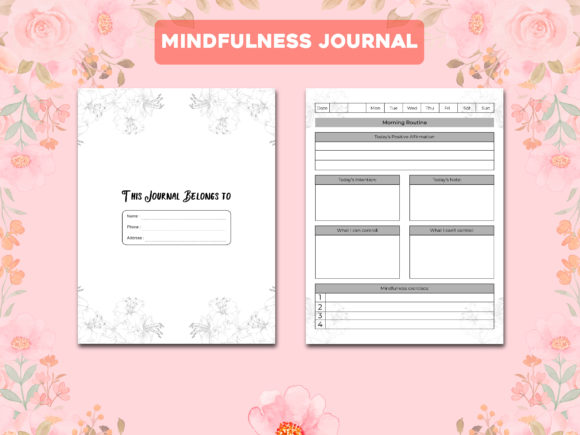
The distinction lies in the prompt structure and visual layout. Effective unisex interiors avoid overly emotive language that may alienate analytical users while maintaining enough depth to satisfy those seeking emotional processing. Instead, they often utilize evidence-based frameworks such as CBT (Cognitive Behavioral Therapy) check-ins, habit tracking grids, and open-ended reflection zones. When evaluating resources for this niche, creators should look for interiors that offer this structural balance rather than decorative filler.
Comparing Template Formats: AI, EPS, PDF, and PPT
When acquiring interior assets for KDP, the file format dictates your workflow efficiency and customization potential. A comprehensive resource package typically includes multiple formats, each serving a different stage of the production process. Understanding when to use Adobe Illustrator (AI/EPS) versus PowerPoint (PPT) or ready-to-upload PDFs is critical for managing time and quality.
Vector Source Files (AI and EPS)
Adobe Illustrator (.ai) and Encapsulated PostScript (.eps) files are the industry standard for scalable vector graphics. These are the master files. They allow you to resize elements without pixelation, adjust line weights, change color palettes to match a new cover design, and modify typography. If you plan to create a series of mindfulness journals with consistent branding but varied internal layouts, vector files are non-negotiable. They provide the flexibility to differentiate your product from competitors using the same base template. However, they require specialized software and a steeper learning curve.
Editability vs. Speed: The PowerPoint Alternative
PowerPoint (.pptx) interiors occupy a middle ground between full design control and instant publishing. For creators who lack vector design skills but need to customize text or rearrange pages, PPT files offer an accessible solution. You can easily swap out prompts, add your logo, or adjust margins within a familiar interface. The tradeoff is resolution and precision; PPT is not a native print design tool, and exporting high-resolution PDFs from it requires careful settings management to avoid blurry text or misaligned bleeds. This format is best suited for rapid testing of new niches where speed matters more than bespoke design.
Ready-to-Upload PDF and Raster Assets
The 100-page ready-to-upload PDF represents the final execution stage. These files should be pre-flattened, correctly sized (typically 6x9 inches for journals), and compliant with KDP bleed requirements. While convenient, relying solely on pre-made PDFs limits differentiation. If ten other sellers download the same pack and upload the PDF unchanged, Amazon’s algorithm may flag the books as duplicate content. Therefore, the included PNG and JPG files serve a vital secondary purpose: they act as modular assets. You can import these raster images into Canva, Affinity Publisher, or InDesign to build unique compositions, ensuring your Mindfulness Journal for Men and Women remains distinct in search results.
Evaluating Quality Standards for KDP Compliance
Technical compliance is the baseline for any KDP business, but quality determines sales velocity. When assessing a mindfulness journal template, several factors separate professional-grade interiors from amateur submissions.
- Margin and Bleed Safety: Mindfulness journals often include writing space near the gutter. Professional templates account for the binding shift, ensuring prompts do not disappear into the spine. Verify that the 100-page PDF includes adequate inner margins (usually 0.375" to 0.5" depending on page count).
- Resolution Integrity: While vectors scale infinitely, PNG and JPG assets must be at least 300 DPI at actual print size. Low-resolution placeholders result in jagged lines and poor customer reviews. Always zoom to 100% to inspect crispness before uploading.
- Prompt Originality: Review the text content within the AI or PPT files. Generic prompts like "What are you grateful for?" are saturated. High-value interiors include nuanced questions tailored to mindfulness practices, such as sensory grounding exercises or stress-response analysis.
- File Organization: A professional asset pack separates source files from export files. Disorganized downloads waste production time. Look for clear labeling that distinguishes between editable masters and print-ready outputs.
Strategic Fit: When to Use Pre-Made Interiors
Acquiring a multi-format interior pack is a strategic decision involving tradeoffs between originality and efficiency. This approach is most effective in specific business contexts.
Ideal Use Cases:
- Market Validation: Before investing weeks in custom design, use the ready-to-upload PDF to test demand for a specific mindfulness angle. If sales occur, justify the time to customize the AI/EPS files for a premium version.
- Series Expansion: If you already have a successful journal, use the vector templates to quickly spin off variations (e.g., a 90-day challenge version or a pocket-sized edition) while maintaining brand consistency.
- Skill Bridging: New publishers can learn design principles by deconstructing professional AI files, observing how layers, styles, and master pages are organized.
Limitations and Risks:
Relying exclusively on unmodified downloads creates vulnerability. Amazon increasingly prioritizes unique customer experiences, and duplicate interiors can lead to suppressed listings. Furthermore, pre-made templates cannot perfectly align with every cover concept. A dark, moody cover paired with a bright, minimalist interior creates cognitive dissonance that reduces conversion rates. Customization is not optional for long-term viability; it is the bridge between a generic asset and a branded product.
Differentiation Strategies in a Crowded Category
The mindfulness niche rewards specificity. While "Mindfulness Journal for Men and Women" serves as a strong foundational keyword, successful products layer additional value propositions onto the base template. Consider how the included file formats enable these differentiations:
Hybrid Functionality: Combine mindfulness prompts with productivity tracking. Use the PPT or AI files to integrate weekly planning spreads or goal-setting matrices. This appeals to users who view mindfulness as a performance enhancer rather than solely a therapeutic tool.
Visual Consistency: Extract design elements from the EPS files to create matching bookmarks, social media graphics, or A+ Content. Using the same geometric shapes or iconography across marketing materials and book interiors builds brand recognition that standalone PDFs cannot achieve.
Customizable Depth: Offer options within the same book. Use the modular PNG assets to create sections with varying line spacing or prompt density. Some users prefer guided reflection; others need blank space for freeform journaling. A flexible template accommodates both without requiring separate products.
Making an Informed Resource Decision
Selecting the right interior assets requires honest assessment of your current capabilities and business goals. If you possess vector design skills and seek maximum uniqueness, prioritize packs with well-organized AI/EPS files and treat PDFs merely as reference proofs. If you are a marketer first and designer second, the PPT and ready-to-upload PDF formats provide necessary speed, provided you commit to at least minor customizations to avoid duplication penalties.
Ultimately, a Mindfulness Journal for Men and Women succeeds when the interior experience delivers on the cover’s promise. The availability of multiple file formats—AI, PPT, EPS, PDF, PNG, and JPG—is not merely a feature list; it is a toolkit for adaptation. By leveraging these resources thoughtfully, creators can navigate the balance between operational efficiency and product distinctiveness, building a KDP portfolio that serves genuine user needs while sustaining commercial growth. Evaluate each asset not just for what it is today, but for what it enables you to build tomorrow.